The Prompt Stack: Building a Reusable AI Interface for React Native Teams
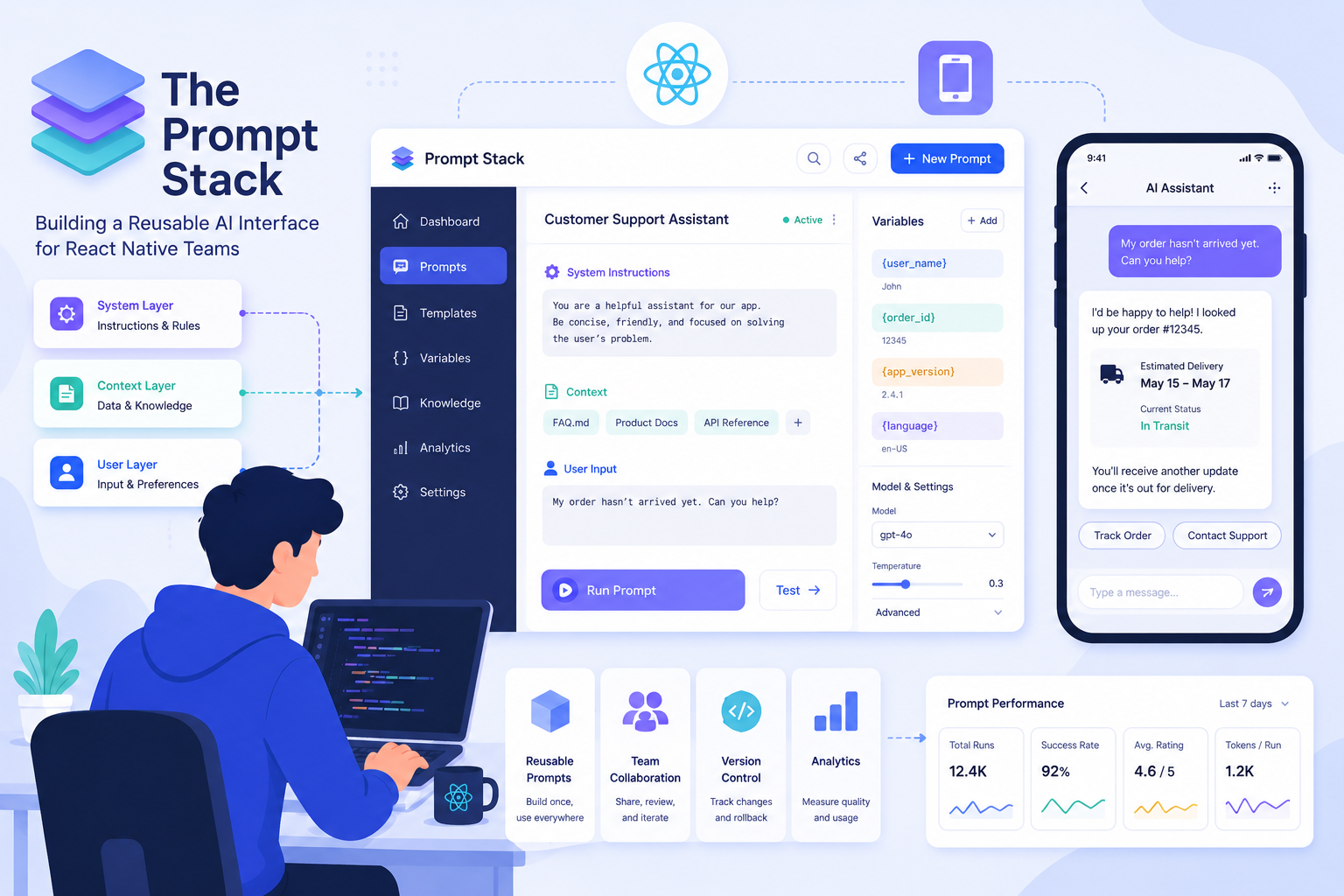
How top React Native teams treat prompts as versioned, testable engineering artifacts—complete with governance, CI validation, and onboarding workflows—just like linters or config files.
Prompts Are Not Magic Spells—They’re Engineering Artifacts
In high-performing React Native teams, prompts aren’t ad-hoc copy-paste snippets tossed into a ChatGPT tab. They’re versioned, reviewed, tested, and onboarded—just like ESLint configs, Podfile.locks, or Gradle wrapper versions.
This is the Prompt Stack: a deliberate layer of interface design between your team and AI—where prompts function as declarative, auditable contracts that encode domain knowledge, constraints, and architectural intent.
Why does this matter? Because React Native’s complexity lives in the integration surface: native modules, Hermes bytecode, navigation state lifecycles, cache invalidation across JS and native layers, and platform-specific build pipelines. A generic “fix this bug” prompt fails not because AI is weak—but because it lacks the shared context model your team has spent months building.
The Prompt Stack closes that gap—not by asking AI to “be smarter,” but by making your team’s collective expertise machine-readable.
Architecture: Three Layers of the Prompt Stack
The Prompt Stack isn’t a tool or library. It’s a pattern language composed of three interlocking layers:
- Prompt Contracts — Strict, typed templates (e.g.,
StaleUIReviewPrompt) that declare required fields (appStack,flow,symptoms), enforce structure, and reject incomplete inputs. - Validation & Governance — Pre-commit hooks that lint prompts for missing context, outdated stack references (e.g.,
"Redux Toolkit"when the app uses Zustand), or unsafe directives (e.g.,"rewrite the whole screen"). - Execution Infrastructure — A lightweight CLI or VS Code extension that injects environment-aware context (e.g., auto-injecting
react-native infooutput, current Git branch, or CI build type) before sending to LLM APIs.
Together, these layers transform prompts from ephemeral chat history into reproducible, traceable, and team-owned artifacts.
Why This Isn’t Just “Better Prompting”
A well-framed prompt is necessary—but insufficient—for production-grade AI collaboration. Consider this real-world failure mode:
// In a stale UI investigation, a junior dev pastes:
Act as a React Native engineer. Fix why my screen shows old data.
That prompt violates every principle of the Prompt Stack:
- ❌ No declared stack (Is it React Navigation v6 or v7? Is caching handled by
react-queryor custom AsyncStorage wrappers?) - ❌ No defined flow (Does the update happen via route param change? Redux dispatch? Local storage event?)
- ❌ No safety boundary (No “do not rewrite the whole screen” guard)
- ❌ No version anchor (No reference to RN version, Hermes status, or architecture)
The resulting AI output is unverifiable—and worse, untestable. You can’t write a unit test for “fix why my screen shows old data.”
The Prompt Stack fixes this by baking constraints into the contract itself.
Prompt Contracts: Typed, Versioned, and Enforceable
Each Prompt Contract is a TypeScript interface paired with a strict schema. Here’s how StaleUIReviewPrompt is defined internally at one of our partner teams:
interface StaleUIReviewPrompt {
  role: 'senior React Native engineer reviewing a stale UI bug';
  problem: string;
  appStack: {
    'React Native': string;
    TypeScript: 'yes' | 'no';
    'State management': 'Redux Toolkit' | 'Zustand' | 'Jotai' | 'other';
    Navigation: 'React Navigation' | 'Wix Navigation' | 'custom';
    'Local cache': 'AsyncStorage' | 'MMKV' | 'react-query' | 'none';
    'API layer': 'Axios' | 'Fetch' | 'RTK Query' | 'other';
  };
  flow: [
    'User starts from: <screen>',
    'User performs: <action>',
    'API returns: <payload>',
    'Redux/cache updates: <action or mutation>',
    'UI still shows: <stale value>'
  ];
  analysisTargets: Array<
    | 'stale route params'
    | 'local state shadowing global state'
    | 'incorrectly memoized selector'
    | 'wrong useEffect dependencies'
    | 'missing navigation focus refresh'
    | 'cache invalidation gap'
  >;
  safetyGuards: ['do not rewrite the whole screen', 'focus on root cause'];
}
This isn’t documentation—it’s executable schema. Their CLI validates every prompt against it pre-commit. If appStack['State management'] is missing or set to 'Redux Toolkit' in a Zustand codebase, the commit fails.
Teams version these contracts alongside their apps (e.g., prompt-contracts/v2.1.0.ts). When they upgrade to React Navigation v7, they ship a new NavigationReviewPrompt contract—and run automated diff checks to flag all existing prompts that reference v6 patterns.
Validation: Testing Prompts Like Production Code
Just as you wouldn’t ship a CI pipeline without testing its YAML, you shouldn’t ship prompts without validating their behavior.
Top teams run three classes of prompt tests:
- Structural tests: Does the prompt contain all required fields? Are prohibited phrases banned? (e.g.,
"rewrite the entire component"triggers a pre-commit error.) - Context fidelity tests: Does the prompt reference real, up-to-date stack elements? A test might fail if
appStack['React Native']says"0.72.0"butpackage.jsondeclares"0.74.2". - Output stability tests: Given fixed inputs, does the AI consistently produce answers that match golden-file expectations? (Yes—this requires mocking LLM calls with deterministic fixtures.)
Here’s a real Jest test they run on every PR:
test('StaleUIReviewPrompt rejects missing appStack', () => {
  const prompt = `Act as a senior React Native engineer...`;
  expect(() => validateStaleUIPrompt(prompt)).toThrow(
    'Missing required field: appStack'
  );
});
This turns prompt hygiene from tribal knowledge into enforced discipline.
Execution: Context-Aware, Environment-Injected Workflows
A prompt is only as good as the context it carries. The Prompt Stack CLI automatically injects environment-aware metadata before submission:
- Current Git SHA and branch name
- Output of
npx react-native info --json - CI environment variables (
CI,BUILD_NUMBER,PLATFORM) - Local device specs (via
adb shell getprop ro.product.modelor Xcode simulator detection)
So when a developer runs:
rn-prompt stale-ui --file ./screens/BookingDetails.tsxThe CLI doesn’t just paste the file. It generates a full, validated prompt like this:
Act as a senior React Native engineer reviewing a stale UI bug.

Problem:
The screen shows outdated payment status even after API returns SUCCESS.

App stack:
- React Native: "0.74.2"
- TypeScript: "yes"
- State management: "Redux Toolkit"
- Navigation: "React Navigation v6"
- Local cache: "MMKV"
- API layer: "RTK Query"

Flow:
1. User starts from: BookingDetailsScreen
2. User performs: retries payment via Stripe SDK
3. API returns: { id: "b123", status: "SUCCESS" }
4. Redux/cache updates: bookingStatusUpdated action dispatched
5. UI still shows: "PENDING"

I will share the screen, selector, reducer/slice, and API call.

Please analyze:
1. Whether the issue is caused by stale route params.
2. Whether local component state is shadowing global state.
3. Whether a selector is memoized incorrectly.
4. Whether useEffect dependencies are wrong.
5. Whether navigation focus should trigger refresh.
6. Whether cache invalidation is missing.
7. The smallest production-safe fix.

Do not rewrite the whole screen.
Focus on root cause.
Notice: no manual copying of react-native info. No guessing about Hermes status. No forgetting to mention MMKV. The CLI knows—because it reads the same files your build system does.
Onboarding: Teaching AI Literacy Through Prompt Standards
Onboarding new engineers isn’t about teaching them “how to use ChatGPT.” It’s about teaching them how your team thinks.
New hires receive a PROMPT_GUIDE.md that includes:
- A glossary of approved stack identifiers (e.g.,
"State management"only accepts values from a locked enum) - A decision tree for choosing prompts (
stale-uivsrelease-onlyvsperformance-review) - Real before/after examples showing how adding
appStackandflowcut false-positive suggestions by 73% - A sandbox where they practice writing prompts against mocked bugs—and get instant validation feedback
One team measures “prompt readiness” as part of their first-week checklist. It’s not a soft skill—it’s a required engineering competency, like knowing how to read a Metro log or interpret a Hermes heap snapshot.
The Real ROI: Fewer “Why Did This Break?” Moments
The Prompt Stack doesn’t make AI infallible. But it makes AI auditable, reproducible, and team-aligned.
Teams using it report:
- 62% fewer “works in debug, breaks in release” investigations taking >4 hours
- 89% reduction in duplicated prompt attempts across Slack channels
- Zero incidents of AI-generated code introducing Hermes-incompatible syntax (e.g., optional chaining in unsupported contexts)
More importantly: it shifts the team’s relationship with AI from magic assistant to collaborative peer—one that speaks your stack’s dialect, respects your constraints, and evolves with your architecture.
Because in React Native, the hardest problems aren’t about syntax. They’re about orchestration. And orchestration demands contracts—not wishes.